skip to main |
skip to sidebar
 No. What you see in this picture is not a temple. It is just an open auditorium outside what is supposed to be a family temple. It was the first temple we visited in Bali and no prizes for guessing how rich the family would be to which the temple belonged.
The brick structure painted in saffron with white contours is the standard look of all the temples in Bali. The golden design usually signifies the entrance to the existence of the shrine. But here, it just is one of structures in the temple field.
The first thing to be noticed here was, wow, all this is so clean!
Also, I posted my Bali Travelogue on Rediff. You can access it here.
 Here is the war against the Rangda where Sahadeva and his men fight her and release her of all her evils. Although Rangda is killed, her one of the followers who is equally powerful continues the fight with the army of Sahadeva in several forms.
Well, so true it is. You may try to eliminate the evil but it always reappears in some form or the other. It reminds me of the last scene from the movie Captain Hook. After reaching the happily-ever-after part of the story that should mark an end of the story, Peter meets Captain Hook himself, for another time. Guys, there can't be only good in this world!
 I always assumed that I knew almost all the stories from Mahabharata. And the very existence of Rangda was a blow to that assumption; forget the stories of her from Mahabharata. But like they say, the language changes every few miles, probably Rangda exists in the Balinese dialect of Mahabharata.
In the very front here, you see Sahadeva with his ministers on both his sides. The story portrays that despite Devi Kunti’s promise to Rangda about sacrificing Sahadeva to her, Sahadeva survives. Lord Shiva had bestowed immortality on Sahadeva before he was to be sacrificed. The story didn't offer any explanation on why, how etc but I really admire the fact that the high level management of things by people in high positions or people who know people in high positions can be traced back to the Mahabharata days!
The traditional plays in Bali have women to play the main (and good) characters. Maybe to bring out the contrast with the evil or to say that how much ever small the good might look, it will always win over the evil. The funny looking, long grey haired character on the right is the evil Rangda. She looked more funny than evil to me.
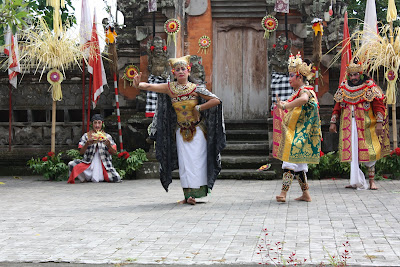
Barong dance portrays a story from Mahabharata where Sahadeva achieved immortality, a story less known to many Indians. What you see in here is Devi Kunti (Balinese refer to Kunti as Devi Kunti without fail!) at the center and Sahadeva to the right of her. Kunti had promised Rangda, an evil witch to sacrifice Sahadeva so Rangda would stop troubling innocent people.
It was difficult to judge the acting skills of these actors because they acted through theor dance based movements. Besides that all the females for some reason spoke in a sqeuaky pitch which was very distracting. Had it not been for the melodious Gambulan, I would have started focusing on other things in the auditorium than the characters. But thanks to the handouts about the show we received at the beginning, we could figure out the characters and the story. Balinese dialogs would have been a simple bouncer otherwise.
 The Barong dance starts not with the Barong act but with these two beautiful ladies in their traditional best instead. The silk robes with intricate golden embroidery made those pretty ladies shine in the morning sunlight. The best part of their ensemble was the Plumeria crowns which were so delicate but suited the ladies with ultimate precision. That was the first time I also realized that I already need a telephoto lens as I could not zoom my 18-55 mm enough to capture only those crowns.
I am not a great admirer of the dances but their performance quite fine with movements similar to those in Bharatanatyam along with the melody of the Gambulan. This dance act gets the play started, after which the Barong enters. And fortunately it lasted only till the time after which I would’ve started yawning.

Barong dance is a very traditional play based on a story from Mahabharata. I was very impressed by the traditional stage on which this play is performed.
As you see here, keeping in mind all the necessary symmetries, elevations from the audience stand, the stage built in the stone has a very authentic touch of the Balinese culture. Even more impressive were the trees on the stage itself which had grown to full heights. Someone really thought through the design while building this open air auditorium some hundred years ago!
The character you see here is the Barong! He is a mythological character, supposed to be powerful and with magical powers. He helps Sahadeva, the youngest of the Pandavas, to defeat an evil witch.

Every nook and corner of Bali is decorated with beautiful sculptures like the ones you see in this picture. On the very first day of our stay there, our guide took us for a local play based on a story from Mahabharata. The way to the open air auditorium was adorned with nicely manicured lawn. What you see in the picture made one of the boundaries of that lush green lawn. I couldn’t resist capturing these some 300-400 years old statues neatly carved in the sand colored stones.
These sculptures are usually organized perfectly against a backdrop of light orange colored brick walls. The effect is not just pious but also endearing. If you notice carefully, even the expressions on the face of the stone dude who is meditating are perfect. Symmetry of the whole sculpture, no need to say, but was flawless.


